Contact centers are under more pressure than ever: customers expect fast, personalized, always-on support, while leaders must control costs and improve efficiency. Contact center artificial intelligence (컨택 센터 인공지능) has emerged as one of the most powerful ways to achieve all three goals at once, shaping the latest AI call center trends.
In today’s rapidly evolving business environment, leveraging emerging technology solutions for enterprise efficiency can transform the way contact centers operate. Advanced platforms designed for large-scale computing and data processing help teams manage customer interactions faster and with higher accuracy. Integrating artificial intelligence with these technologies allows organizations to optimize workflows and reduce repetitive tasks.
Effective contact centers also benefit from innovative online marketing strategies for engagement, which help attract and retain customers while providing meaningful experiences. By analyzing behavior and personalizing messaging, companies can build stronger relationships and improve satisfaction. Tools focused on digital marketing performance for customer acquisition give agents actionable insights that make each interaction more productive.
Financial management is another key area where contact centers can improve performance. Implementing strategies for efficient corporate financial planning ensures resources are allocated wisely and supports sustainable growth. Using data-driven approaches for budgeting and investment decisions can directly impact a contact center’s ability to adopt AI and technology enhancements successfully.
Finally, staying ahead in this landscape requires monitoring trends in technology-driven customer experience improvements. By combining advanced computing, digital marketing insights, and sound financial planning, businesses can fully harness the power of contact center artificial intelligence, creating smarter operations, empowered agents, and happier customers.
Top 10 Contact Center Artificial Intelligence Solutions
In the modern customer service landscape, contact center artificial intelligence is transforming how businesses engage with their customers. AI-powered tools help improve agent efficiency, reduce response times, and deliver personalized experiences. Here is a list of the top 10 AI contact center platforms to consider:
1. Bright Pattern
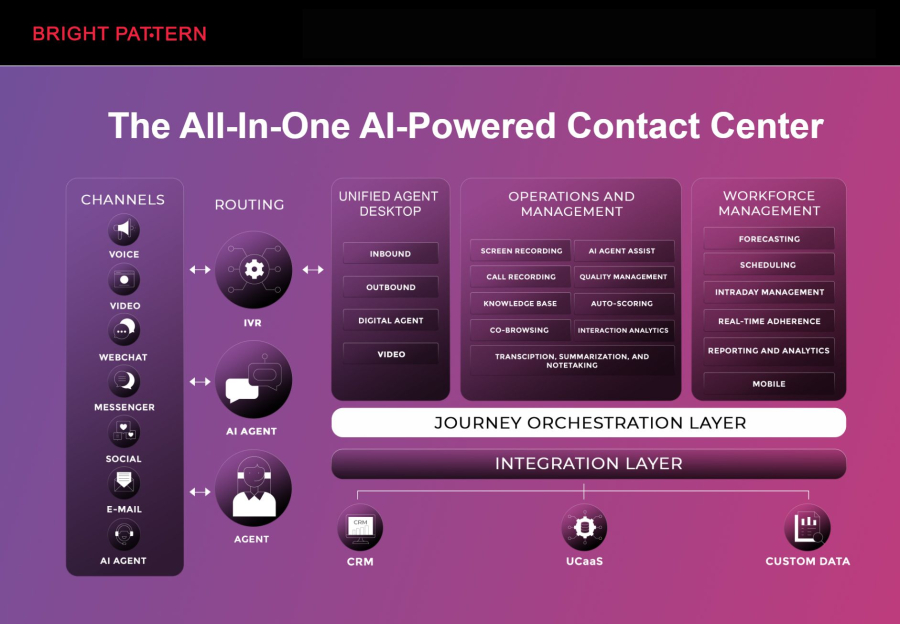
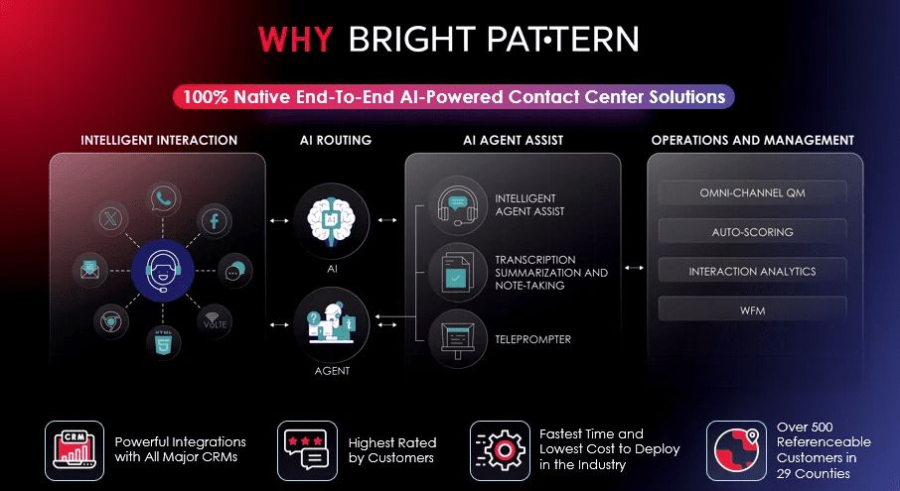
Bright Pattern is a leading contact center solution known for its comprehensive AI capabilities. Designed to support omnichannel interactions, Bright Pattern enables businesses to deliver seamless and personalized customer experiences.
Key features:
- AI-powered routing to connect customers with the right agent quickly
- Real-time sentiment analysis for improved agent guidance
- Omnichannel support including voice, chat, email, and social messaging
- Automated workflows and intelligent self-service options
- Analytics dashboards for performance monitoring and insights
Bright Pattern’s AI tools help contact centers reduce operational costs while improving customer satisfaction. Its scalable architecture ensures that businesses of all sizes can adopt AI-driven solutions to streamline operations and enhance agent productivity.
2. Genesys
Genesys offers AI-driven solutions for predictive routing, chatbots, and workforce optimization. It focuses on delivering personalized customer journeys across multiple channels.
3. NICE inContact
NICE inContact provides AI-powered analytics and automation tools to help contact centers optimize performance and improve customer engagement.
4. Five9
Five9 uses artificial intelligence for intelligent routing, virtual assistants, and predictive analytics to enhance agent productivity and customer satisfaction.
5. Talkdesk
Talkdesk offers AI-powered automation and real-time insights, helping agents provide faster and more accurate responses to customer inquiries.
6. RingCentral Contact Center
RingCentral integrates AI to optimize call routing, automate repetitive tasks, and provide advanced analytics for performance improvement.
7. 8x8 Contact Center
8x8’s AI-driven solutions focus on enhancing customer experience through smart routing, sentiment analysis, and AI-powered self-service.
8. Zendesk
Zendesk leverages AI to automate support workflows, suggest responses, and provide predictive insights that improve agent efficiency.
9. HubSpot Service Hub
HubSpot combines AI with CRM data to automate ticketing, provide chatbot support, and offer performance analytics for contact center teams.
10. Salesforce Service Cloud
Salesforce Service Cloud uses AI to guide agents, automate responses, and deliver predictive insights for better customer engagement and faster resolution times.
What Is Contact Center Artificial Intelligence?
Contact center artificial intelligencerefers to the use of AI technologies to improve and automate customer interactions across voice and digital channels. It works alongside your human agents to handle simple tasks, surface insights, and guide better decisions in real time.
Contact center AI commonly includes:
- Virtual agents and chatbotsthat engage customers through voice or chat.
- Natural language understanding (NLU)that recognizes what customers mean, not just what they say or type.
- Machine learningmodels that learn from interactions to recommend next best actions.
- Speech and text analyticsthat analyze conversations at scale for quality, trends, and compliance.
- Automation toolsthat trigger workflows, update systems, and reduce manual effort.
The result is a more intelligent, responsive, and scalable contact center that can support both customers and agents across every touchpoint.
Why Contact Center AI Matters Now
Customer expectations have shifted dramatically. People want:
- Instant answersat any time of day, on any channel.
- Personalized experiencesbased on their history and preferences.
- Low-effort interactionsthat do not require repeating information or waiting on hold.
At the same time, contact centers face:
- High interaction volumesacross phone, email, chat, social, and messaging.
- Agent shortages and high turnoverthat drive up recruitment and training costs.
- Pressure to reduce costswhile improving quality and compliance.
Contact center artificial intelligence directly addresses these challenges by handling routine work, guiding complex interactions, and giving leaders deep visibility into customer needs and operational performance.
Core Capabilities of Contact Center Artificial Intelligence
1. Virtual Agents and AI Chatbots
Virtual agentsare AI-powered systems that interact with customers via voice or text. They use natural language understanding to interpret questions and respond conversationally.
Common use cases include:
- Answering frequently asked questions.
- Resetting passwords or updating account details.
- Checking order status, balances, or reservations.
- Scheduling, rescheduling, or canceling appointments.
- Routing customers to the right human agent when needed.
When designed well, virtual agents provide fast, consistent service and can operate 24/7 without wait times. They are particularly effective for high-volume, low-complexity interactions that do not require human judgment or empathy.
2. Intelligent Routing and Triage
AI-powered routinggoes beyond basic skills-based routing. It can analyze customer intent, sentiment, and history to determine the best destination for each interaction.
Examples of intelligent routing include:
- Detecting urgency or frustration and prioritizing those interactions.
- Matching customers with agents who have specific expertise or language skills.
- Directing simple requests to virtual agents and complex cases to specialists.
- Balancing workloads across teams and queues to reduce wait times.
This leads to faster resolution, fewer transfers, and more effective use of your most skilled agents.
3. Real-Time Agent Assist
Agent assisttools use AI to listen to or read live conversations and offer real-time support to human agents. This is one of the most powerful ways to improve both customer experience and agent confidence.
Real-time agent assist can provide:
- Suggested responses or next best actions during a call or chat.
- Prompts for required disclosures or compliance statements.
- Instant access to relevant knowledge base articles.
- Reminders to show empathy or de-escalate when sentiment turns negative.
- Automated summaries after the interaction to speed up wrap-up time.
With this support, new agents ramp up faster, experienced agents handle more complex work with ease, and customers receive more accurate and consistent answers.
4. Quality Management and Conversation Analytics
Traditional quality management relies on supervisors manually reviewing a small sample of interactions.AI-driven analyticscan analyze nearly every call, chat, or message for quality, sentiment, and compliance.
Capabilities often include:
- Automatic transcription of calls into searchable text.
- Keyword and phrase detection for compliance and product mentions.
- Sentiment analysis to identify frustration, satisfaction, or confusion.
- Trend analysis across teams, locations, and channels.
- Scorecards and coaching insights generated from objective data.
This makes quality programs more fair, consistent, and impactful while revealing systemic issues that drive repeat contacts or dissatisfaction.
5. Automation and Workflow Orchestration
Contact center artificial intelligence often integrates with robotic process automation and back-end systems toautomate repetitive tasksthat previously consumed agent time.
Automations can be triggered by:
- Specific phrases or intents detected in a conversation.
- Form fields completed during a chat or call.
- Customer actions in self-service portals or apps.
Typical automated workflows include updating records, creating tickets, processing simple transactions, and sending follow-up confirmations. This reduces handle time and allows agents to focus on solving customer problems rather than navigating systems.
Key Benefits of Contact Center Artificial Intelligence
1. Better Customer Experience
When used thoughtfully, contact center AI enhances customer experience at every stage of the journey.
- Faster servicethrough instant answers and reduced wait times.
- 24/7 availabilitywithout the need to staff around the clock.
- Personalizationbased on past interactions, preferences, and context.
- Omnichannel consistencyas AI supports voice, chat, messaging, and email with the same level of quality.
Customers feel recognized, respected, and supported, which strengthens loyalty and increases the likelihood of repeat business and positive word-of-mouth.
2. Empowered and Engaged Agents
AI is most successful when it is positioned as aco-pilot for agentsrather than a replacement. With the right design, agents benefit from:
- Reduced repetitive workas AI handles routine questions and tasks.
- Real-time guidancethat improves accuracy and confidence.
- Faster access to knowledgeinstead of searching through multiple systems.
- More interesting interactionsas they focus on complex and high-value cases.
This typically leads to higher job satisfaction, lower burnout, and better performance across the board.
3. Increased Efficiency and Cost Optimization
Contact center artificial intelligence makes it possible to serve more customers with the same or fewer resources. Efficiency gains come from:
- Deflecting simple contactsto self-service and virtual agents.
- Shortening handle timewith agent assist and automation.
- Reducing repeat contactsby improving first contact resolution.
- Optimizing staffingas AI provides more accurate forecasts and routing.
While every organization is different, many leaders find that AI allows them to absorb growth and seasonal spikes more smoothly without linearly increasing headcount.
4. Stronger Revenue and Upsell Opportunities
AI does not just reduce costs; it can alsogrow revenueby enabling smarter, more relevant offers during service interactions.
For example, AI can:
- Identify cross-sell or upsell opportunities based on customer history.
- Recommend tailored offers that genuinely fit customer needs.
- Support agents with compliant scripts and accurate pricing details.
Because the offers are better targeted and better timed, customers are more likely to say yes, turning the contact center into a meaningful revenue channel while maintaining a service-first mindset.
5. Improved Compliance and Risk Management
Regulated industries face strict requirements for disclosures, record-keeping, and complaint handling. Contact center AI supports compliance by:
- Prompting agents to deliver required statements at the right moment.
- Capturing complete transcripts and summaries for audit trails.
- Flagging potential compliance risks for supervisor review.
- Providing consistent responses to sensitive questions.
This reduces the likelihood of non-compliant interactions and gives compliance teams greater visibility into what is happening across thousands of daily contacts.
Where Contact Center Artificial Intelligence Delivers Big Wins
Contact center AI can add value in almost any industry. Here are some typical scenarios.
Retail and E‑Commerce
- Virtual agents handle order tracking, delivery updates, and returns.
- AI recommends relevant products or services during support interactions.
- Sentiment analysis flags delivery or product issues early.
Banking and Financial Services
- Self-service for balances, recent transactions, and card activation.
- AI triage for suspected fraud and lost or stolen cards.
- Real-time prompts to support disclosure obligations and security checks.
Telecommunications and Utilities
- Automated troubleshooting flows for connectivity and device issues.
- Proactive notifications about outages and restoration times.
- Smart routing for billing disputes vs. technical support.
Healthcare and Insurance
- Appointment scheduling and reminders via voice or chat.
- Eligibility, benefit, and claim status inquiries automated end to end.
- AI support for agents dealing with complex approval or authorization cases.
B2B Services and SaaS
- Tier 1 technical support automated with guided troubleshooting.
- In-product support bots that connect to live agents when needed.
- Analytics revealing feature adoption issues and training needs.
How to Implement Contact Center AI Successfully
A structured approach helps you unlock value quickly while managing risk and change. The following steps are a practical roadmap.
1. Clarify Objectives and Success Metrics
Start with the outcomes you want to achieve. Common goals include:
- Improving customer satisfaction or net promoter scores.
- Reducing average handle time or queue times.
- Increasing self-service containment rates.
- Boosting agent productivity and engagement.
- Enhancing compliance and reducing errors.
Define a small set of measurable KPIs before you select tools or design flows. This ensures that every AI initiative is tied to real business value.
2. Map Customer Journeys and Identify High-Impact Use Cases
Analyze your interaction data to understand why customers contact you and where friction exists. Then choosehigh-impact, low-complexity use casesfor your initial AI projects, such as:
- Top five repetitive inquiries that follow a predictable pattern.
- Common after-call tasks that can be automated.
- Areas where agents frequently search for information.
Starting small with clear wins builds momentum and buy-in for broader transformation.
3. Design Human-Centered Experiences
A successful AI contact center still feels human. Design your experiences with empathy:
- Use natural, clear language in prompts and responses.
- Offer easy ways to reach a human when needed.
- Set expectations about what the virtual agent can and cannot do.
- Test flows with real customers and refine based on feedback.
Customers are more accepting of AI when it is transparent, helpful, and respectful of their time.
4. Involve Agents Early and Often
Agents are a critical part of successful adoption. Engage them from the beginning by:
- Explaining how AI will support their work, not replace it.
- Gathering feedback on pain points AI can help solve.
- Including experienced agents in testing and design.
- Providing training on how to use new tools effectively.
When agents see AI reducing their workload and improving customer outcomes, they quickly become advocates.
5. Pilot, Learn, and Scale
Rather than a big-bang rollout, launch AI capabilities in controlled pilots:
- Start with a limited set of scenarios or channels.
- Monitor performance and customer feedback closely.
- Adjust conversation flows, routing rules, and automation logic.
- Gradually expand scope as confidence and results grow.
This iterative approach reduces risk and accelerates learning while still delivering tangible value quickly.
Building the Right Data and Technology Foundation
Contact center artificial intelligence thrives on high-quality data and strong integrations. Consider the following components.
Unified Customer Data
AI performs best when it can access a complete view of the customer, including:
- Profile information and preferences.
- Interaction history across channels.
- Transaction and purchase data, where appropriate.
- Support tickets, notes, and case resolutions.
A unified data layer enables more accurate personalization, better routing, and more relevant recommendations.
Integration with Core Systems
To move from insights to action, your AI tools should connect to:
- Customer relationship management systems.
- Order management, billing, or policy administration platforms.
- Knowledge bases and document repositories.
- Workforce management and quality monitoring applications.
These integrations let AI update records, launch workflows, and surface the right information at the right time.
Security, Privacy, and Governance
Responsible AI requires strong governance, especially in regulated sectors. Key practices include:
- Clear policies on data retention and access control.
- Encryption of sensitive data in transit and at rest.
- Regular reviews of models for bias and unintended outcomes.
- Transparent communication to customers about how AI is used.
By embedding governance in your design from day one, you build trust and reduce the risk of future issues.
Measuring the Impact of Contact Center AI
To sustain investment and improvement, you need to track the effect of AI initiatives over time. Useful KPIs include:
Customer Experience Metrics
- Customer satisfaction scores after interactions.
- Net promoter scores or loyalty indicators.
- Contact effort scores, such as how easy it is to get help.
- First contact resolution rates.
Operational and Financial Metrics
- Average handle time and queue time.
- Self-service containment and virtual agent success rates.
- Agent productivity and occupancy.
- Cost per contact or cost per resolved case.
Employee Experience Metrics
- Agent satisfaction and engagement survey results.
- Training and ramp-up time for new hires.
- Attrition rates, especially in early tenure.
By comparing performance before and after AI deployments, you can quantify benefits, refine strategies, and prioritize the next wave of innovation.
Addressing Common Concerns about Contact Center AI
Adopting contact center artificial intelligence is a strategic shift, and questions are natural. The following points can help guide internal discussions.
Will AI Replace Human Agents?
In most organizations, AI is used toaugment humans, not replace them. It takes on repetitive, low-complexity tasks so agents can focus on high-value work that requires empathy, creativity, and judgment.
Over time, the role of the agent evolves from answering simple questions to becoming a trusted advisor and problem solver.
Is AI Accurate and Reliable Enough?
Modern AI has advanced significantly, but it is not perfect. Accuracy improves when:
- Models are trained on relevant, high-quality data.
- Use cases are clearly defined and within the system's capability.
- There is an easy path to escalate to humans when needed.
- Performance is monitored and tuned regularly.
By starting with well-bounded use cases and continuously optimizing, organizations build reliability and confidence over time.
How Do We Maintain a Human Touch?
The key is to use AI in a way thatenhances humanityrather than replacing it. Practical steps include:
- Designing AI voices and personas that are clear, respectful, and concise.
- Allowing customers to reach a human easily at any point.
- Using AI to provide agents with context so they can be more empathetic.
When done well, customers often experience AI as a faster path to the right human help, not as a barrier.
The Future of Contact Center Artificial Intelligence
Contact center AI is evolving quickly, opening new possibilities for customer engagement.
Generative AI for Natural Conversations
Generative AIcan create more natural, flexible responses based on large language models. When safely constrained and supervised, it can:
- Draft personalized replies that agents can quickly review and send.
- Generate concise call summaries and next-step documentation.
- Support richer, more human-like virtual agent experiences.
The focus for many organizations is on using generative AI as an assistant that saves time and enhances quality, rather than letting it operate entirely autonomously.
Proactive and Predictive Service
As AI models learn from more data, contact centers can shift from reactive toproactive service. Examples include:
- Reaching out to customers before a known issue affects them.
- Suggesting guidance or education based on usage patterns.
- Alerting agents to likely needs before a call even begins.
This turns the contact center into a strategic hub for customer loyalty and retention.
Deeper Integration Across the Customer Journey
In the future, contact center AI will be even more tightly integrated with marketing, sales, and product teams. Insights from conversations will inform:
- Product roadmaps and service design.
- Targeted campaigns and personalized offers.
- Customer success programs and onboarding journeys.
This creates a continuous feedback loop where every interaction helps improve the entire customer experience.
Conclusion: Turning Your Contact Center into an AI-Powered Advantage
Contact center artificial intelligence is not just a technology trend. It is a practical, powerful way to elevate customer experience, empower agents, and unlock new levels of efficiency and insight.
By starting with clear goals, focusing on high-impact use cases, and designing human-centered experiences, you can build an AI-enhanced contact center that delights customers, reduces friction, and positions your organization for long-term success.
Organizations that embrace AI thoughtfully today will be the ones setting customer service standards tomorrow. With the right approach, your contact center can become a strategic advantage and a key driver of growth.
